The Hunger Games Costumes: A Brief Review

This will be short stream of consciousness, scant of any proper analysis- you’ve been warned.

I loved The Hunger Games book series, written by Suzanne Collins. In 2012 Lionsgate release an adaptation of the first book in the series, and I was so excited to see the dystopian world of Panem realised.

As a fan of the books, there was a lot that I was looking forward to, but the one thing I was most looking forward to see was the costume design. In The Hunger Games books clothing is a main feature, highlighting fashion’s power to convey important socio-political messages.

I have loved fashion and costume design ever since I was little so I was eager to see what the filmmakers had in store. And yet I remember leaving the cinema feeling disappointed in the film’s interpretation of fashion of Panem, and I couldn’t put my finger on why that was.

Well it’s been nearly ten years and I’ve had plenty of time to think about it, and I think I’ve pinned down the issue I have with these costumes.

I’d like to make clear that I am in no way implying that the designers for these films did a bad job. These costumes are undeniably well designed and create a fully realised world for these films to take place in.

I’d also like to make clear that I completely understand that books are open for interpretation, and just because the costumes did not perfectly fit what I imagined when reading the books it doesn’t mean they’re wrong.

Now I’ve made those two things clear, time to completely disregard them. THE HUNGER GAMES COSTUME DESIGNERS DID A BAD JOB AND THEIR INTERPRETATION IS WRONG! joke.

But I do think they missed an opportunity with the costume design to turn the mirror on the audience, particularly the design of the Capitol citizens.

The Hunger Games is set some time in the near future, but if you look at the costumes particularly in the first film, you can see a clear late 17th, 18th and early 19th Century influence. Large wigs, fans, powdered faces, gloves, corsets, the whole shebang.

The books establish that wigs and makeup are commonplace in the Capitol, but for the films that could have just as easily be interpreted as this-

Kylie Jenner (booooo)

or this or this. 

Belle Delphine (booooo)

Both of these examples keep the aesthetic rooted in a familiar reality, which is kind of what I expected to see but with a futuristic flavouring to it.

But, Judianna Makovsky (costume designer), Ve Neill and Linda Flowers (hair and makeup) decided to go with this…
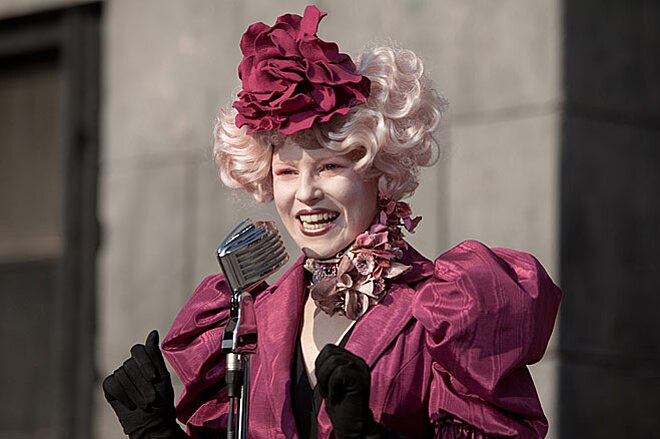
Elizabeth Banks (yayyyy)

…creating a culture that draws inspiration from British and European styles around and after the time of the American revolution. I found this sophisticated socialite take on the Capitol surprising, as in the book they never really struck me as a society of class, but of gross excess and waste.

The visual implication seems to be clear here. The Capitol are the British (also characterised by their transatlantic accents). And the Thirteen districts of Panem are the Thirteen Colonies of America. Sorted. And these are all fair adaptational choices.

But for a book series that was praised for being highly political the costumes of the 2012 adaptation of The Hunger Games feels like a futuristic retelling of American history. This Revolutionary influence positions the viewer (particularly American viewers) as the downtrodden rebels, versus an aristocratic ruling class.

But this has always felt wrong to me, the book’s Capitol citizens are people of gross excess, constantly changing fashions. They’re not hoity-toity aristocrats tottering around in corsets and powdered wigs- yes I am stating my interpretation as fact, sue me.

The Capitol has a reliance on fast fashion made by exploited workers…

…food produced and farmed by exploited workers…

…and a love of voyeurisitic entertainment that exploits the pain and humiliation of others, and entertainment depicting violent death…

well I kind of felt like the book was telling us that WE are the Capitol. We being the modern West.

But the design of the characters creates such a visual difference from that message, that The Hunger Games doesn’t feel like the inevitable future of Capitalism and our society’s greed, excess, vapidity, and relative ignorance of the unseen human cost.

The film’s Capitol is a total fantasy, with none of the social commentary of the books. The costumes seem more concerned with America’s rebellious past rather than its present.

The films’ costumes become further estranged from the books with successive instalments, featuring avant-garde runway pieces from such fashion houses as Alexander McQueen and The House of Worth…

…pushing the Capitol from the realms of the aristocracy, to the aristocracy in haute couture, ‘flanderizing’ their aesthetic even more.

All the Capitol citizens look like they’ve just come off a runway, or stepped out of a history book in every scene. Nobody ever looks like they’re just nipping out to the shops, or coming back from work, I just don’t buy it. I wish the filmmakers had taken a different approach, incorporating more casual and streetwear looks.

YES the books describe the Capitol as extravagant, but the books are written entirely from Katniss’s point of view, and she has lived her whole life in abject poverty.

If you lived in abject poverty wouldn’t brightly coloured clothing look extravagant to you? The costumes should have been extravagant to Katniss, but more familiar to the audience.

Not only would a more grounded and varied aesthetic be more believable, but it would also highlight comparison between the Capitol and the audience- a relevant comparison if you ask me.

Woman compares Western Culture and the Capitol

The costumes in The Hunger Games films are great, theres no denying it (even if it seems like I’m denying it), but I feel they would’ve been more impactful if they had taken the books’ lead in conveying social issues to an audience through fashion, rather than conveying…

…that you should buy Alexander McQueen? Idk. Maybe I’m missing the point.

What do you think? Comment below or beef me on instagram.

Joe Jordan x

Gay Icons: Conduits of Pride

Last week I tweeted some pictures of my favourite Spice Girl, Geri (aka ‘Ginger Spice’). The caption read ‘Gay Icon Spice’, because of all the Spice Girls I regard Geri to be the biggest gay icon.

A friend then messaged me asking what exactly I meant by ‘gay icon’, and what constitutes one? He had heard this term frequently used, but not frequently defined. I think many people have a general idea of what this term means; some names and faces that come to mind immediately.

I asked my followers on Instagram earlier this week who they thought of as a gay icon, and the same names kept coming up. Lady Gaga, Madonna and Cher.

I also asked people to define the term ‘gay icon’, and there was a general understanding that gay icons are:

  1. Supported by LGBTQ+ people. 
  2. Supportive of LGBTQ+ people.

But there are lots of people who are well liked amongst the LGBTQ+ community, and people who are supportive of the LGBTQ+ community, but are far from gay iconhood. So what is it exactly? It must be more than that.

When thinking of how to answer my friend’s questions, I thought of characters and celebrities that connected with me from a young age, and why so many of them connected with other queer people I’ve met or seen online.

So in my view, it’s all about representation, or lack thereof. LGBTQ+ representation has been pretty scarce until recent years, so often ‘gay icons’ have acted as conduits of queerness. Take Ginger Spice for instance, she’s empowered, glamorous, camp and proud to be who she is.

Or think of Judy Garland, an archetypal gay icon. Dorothy Gale was a young misunderstood girl living in the middle of nowhere, who dreamed of far off lands over the rainbow, and was swept away to a colourful world of queer characters (pun intended).

I’m sure you can see why these traits and desires would resonate with a young child who feels different to those around them, and has dreams of escape to life of glamour, where they can be who they are with pride and without ridicule.

The feeling of resonance could also explain why many villainous characters from fiction are dubbed gay icons- or at least are popular with queer people.

Characters like Poison Ivy, Cruella De Vil, Winifred Sanderson and Ursula the Sea Witch (who was actually inspired by Drag Queens).

These characters are theatrical and camp, and they broadcast these aspects of their personality proudly.

True they are villains, but LGBTQ+ people have often been vilified in media, so it’s hardly surprising to see queer acting characters in these roles- until recently queer people were almost never at the centre of major stories.

You should check out this video on Queer Coding to learn about one of the ways LGBTQ+ people have been portrayed in film and television.

And while I’m recommending something to watch, you should watch ‘Disclosure’ on Netflix to see how Trans Representation in media has shaped our ideas of Trans and/or Queer people.

With an historical lack of representation, is it surprising that queer children and adults rally around heterosexual celebrities and characters who transgress societal norms and/or who embody a feeling of dissociation from those around them? These people, typically liberated feminist women, speak to the queer experience and a desire to also be liberated from societal constraint.

What distinguishes a gay icon is an element of the transgressive, possibly even monstrous, which is exemplified in Lady Gaga, an undisputed gay icon. It’s not just her love and support of queer people that makes her an icon, it’s her flare and theatrics, and her understanding of what it’s like to feel different- to feel like a monster, she even calls her fans her ‘little monsters’.

Gay icons have historically served as conduits of queer pride, but as we see more and better representation of queer people and their voices, and more people speaking about LGBTQ+ issues, it’s increasingly hard to define who’s a gay icon and who isn’t, because there are just so many candidates.

The experiences of LGBTQ+ people is becoming less homogenised in media and individual voices are being acknowledged, so the term is beginning to be blown wide open.

That’s why you might hear some people say that Taylor Swift or Katy Perry are gay icons, and some people vehemently disagree.

Some people might be happy Billboard naming Ariana Grande the gay icon of our generation, whereas other people… like myself… are horrified by this- honestly, even Pennywise the Dancing Clown would have been a better choice (yes, he’s been described as a Gay Icon too).

The truth is, as queer people continue to voice their own stories and experiences, and our ideas of sexuality and gender change, we might see the term ‘gay icon’ fade away. But for now we can continue to dub our favourite Spice Girls gay icons, and write blog posts on the subject.

But what do you think?

Comment below or beef me on Twitter/Instagram @__joejordan

Also one last thing. I deliberately didn’t include any icons who are actually queer, as my focus was on defining and providing explanation for why the majority of ‘gay icons’ are heterosexual, beyond the fact that they are LGBTQ+ allies. I know Freddie Mercury and Elton John are gay icons. Freddie Mercury especially is a huge inspiration to me, and if you’re a gay man that hasn’t been compared to Freddie Mercury at least once in your life then you seriously need to consider a wardrobe makeover.

Anyway, let’s chat again soon.

Joe Jordan x

Today I Tidied My Room

Today I tidied my room. It never fails to amaze me how a simple thing like tidying your room can make you feel so much happier.

I’ve been meaning to tidy mine for about half a millennia, and I ashamed to say that when I finally did it today the whole operation was more like an archeological excavation than a bedroom tidy.

But as I dug up fossilised laundry that went extinct millions of years ago, I could feel my spirits lifting. Being able to see my bedroom floor was like being able to think clearly again.

I have no shame in admitting that I can be a generally sad person, I’m not owning it or anything, happiness is definitely my colour, but sometimes it inexplicably escapes me for weeks on end.

I was recently talking to a friend about sadness and what to do when it feels like the walls are closing in around you. She said she’d recently tried running and can now add that to her list of ‘tried and tested’ methods to fight sadness. ‘Now I know’ she said, ‘that when I feel down I can go for a run. Even if I don’t feel like it, I know it works. It’s tried and tested.’

While I’ve still to put on my running shoes (or buy running shoes), it got me thinking of my tried and tested methods. What do/can I do when I feel down?

Tidying my room for one. Another friend once said to me ‘tidy room, tidy mind’… I know she wasn’t the first person to say that, I know was probably Jesus or Buddha… but I’ve never forgotten her advice. So now I try to keep my room tidy, and if you’ve seen the size of my wardrobe you know it’s not easy.

Friends also make me happy, and while it can be an instinct to cut yourself off from the world when your down, there’s no better medicine than laughter. I recently went to the pub with an old friend I hadn’t seen in a while and we had such a nice evening.

‘It can be hugely helpful and very redemptive to catch up with [old friends]… these people serve conduits to earlier versions of ourselves.’ I found this video on the benefits of old friends a few years ago, you should definitely check it out.

Setting small targets for yourself can also be a great way of feeling like you’re in control when your emotions are getting the best of you. Honestly for me, hitting a target as small as ‘watch an episode of the Witcher while I wash and dry up all the plates’ can give a sense of achievement (albeit completely undeserved).

I also love to write, which is why I am writing this post (it was one of my small targets for today), and I feel better still. Tried and tested. The proof is in the pudding with these things.

Revisiting a toxic person, or drinking, or watching a bunch of trash tv might make you feel better for an evening, but it won’t last. It can be tempting to take drastic action to make your life better, but that can be hard to keep up. You have to make lots of little changes to see positive results in your life.

It might seem perfectly obvious to some of you, but those of us who live our lives like one big Shakespearean tragedy, it can sometimes be hard to see the wood for the trees.

Anyway, today I tidied my room and I feel great.

Bit of a random post from me, not my usual vibe, but it’s nice to shake things up. What are your tried and tested methods to fight sadness? Comment below or @ me on insta @__joejordan.

All love,

Joe Jordan x

Why you should watch ‘The Handmaid’s Tale’ (+ others)

I’m just going to throw it out there, ‘The Handmaid’s Tale’ is one of the best series currently on television.

I love this show so much, and yet it seems as if not many people have watched it. I know only a handful of people who watch this gem of television, and I think it’s a darn travesty that when I put up a poll on instagram yesterday, only 30% of people said they’ve seen it.

The season 3 finale came out yesterday and I am going to pitch to you exactly why you should catch up on The Handmaid’s Tale before season 4 is released next year.

Lets start with the premise.

The Handmaid’s Tale is based on a 1985 novel by Margaret Atwood. It is set in a dystopian near-future, where fertility rates have plummeted, and war and natural disasters have destroyed the world.

The story is set in what used to be the United States of America, now named ‘The Republic of Gilead’, an authoritarian religious state ruled by a group of men known as ‘The Commanders of the Faithful’.

The Commanders have enforced a strict religious moral code on the citizens of Gilead. Women may no longer read or write, and must walk around in pairs. Sexual and religious minorities are indiscriminately executed. Even scientists, doctors, and members of other Christian denominations are not safe.

Due to environmental issues most people are infertile, only a few number of women are able to get pregnant. In Gilead, these women have been rounded up to ‘serve the commanders and their barren wives.’

In other words, to be breeding machines for the elite. These women are known as ‘Handmaids’. Handmaids have all of their agency, and individual identity stripped from them.

They are forced to give up their birth names, and take on names to indicate the Commander they serve. They have names like ‘Ofglen’, ‘Ofwarren’ and ‘Ofsteven’. Our protagonist is ‘Offred’, meaning she is ‘of Fred’.

The rest of society is divided up into a strict class system, women in particular are sorted by function.

The Wives of the Commanders are the highest ranking women in society. They wear blue, relating to Mary, Mother of Jesus.

‘Marthas’ are domestic servants, named after Martha from the Bible- who busied herself serving Jesus Christ. They wear a pale green.

Aunts are the strict overseers of the Handmaids- they wear brown. This is Aunt Lydia… she is the most awful character in the show, and you will absolutely love hating her.

As for the men, well they’re pretty much either divided into politicians (Commanders of the Faithful) or soldiers (Guardians of the Faith), and almost always wear black. That brings me to my second reason that you should watch The Handmaid’s Tale. The whole look of the show.

The costume design is just fantastic. The Handmaids’ costumes are evocative of American Puritanism…

The Wives’ costumes evoke the dress of 1950s housewives…

and the Aunts’ costumes evoke the Nazi uniform.

Costume designer Ane Crabtree has created a world that reminds us of bygone eras, but yet still keeps this show feeling contemporary.

The sets are also beautiful, keeping a very consistent colour palette all the way through, and if you’re a fan of cinematography you’ll love how elegantly this story is told through the camera.

Here’s a video I’ve found dissecting the cinematography, but be careful, there are spoilers.

The third reason you should watch The Handmaid’s Tale is for the characters. I love a character based drama, and since the last season of Game of Thrones decided to nose dive every single last one of its characters…

…The Handmaid’s Tale has been giving me my fix of complex and consistent characterisation. Yvonne Strahovski plays ‘Serena Joy’, who is the wife of Commander Fred Waterford, the Commander our main character serves.

She is perhaps the most morally grey character on TV right now, The Handmaid’s Tale is worth watching just for her.

And if you’ve read the book, I think you’ll find this character an especially enjoyable update on book Serena Joy.

The fourth reason you should watch ‘The Handmaid’s Tale’ is its social and political relevance.

Author Margaret Atwood told People Magazine:

“There’s a precedent in real life for everything in the book, I decided not to put anything in that somebody somewhere hadn’t already done. But you write these books so they won’t come true.”

The Handmaid’s Tale shows how authoritarian and/or religious states work, how they manage to engineer and subjugate the masses.

How propaganda, and lack of proper information blurs the lines between what’s right and what’s wrong.

Some have compared the forming of Gilead to the Trump administration, and the apparent rise of religious conservatism in America. I personally think that’s a bit of a stretch, but I can see where that idea comes from.

I think a more relevant real-world comparison are the actual countries where women are not allowed to read and write, or drive, have no reproductive or political rights and have an enforced religious dress code… much like the women in The Handmaid’s Tale.

This show hits a lot of home truths about the effects of religious states, and I think there is no better time than now to release media like this.

The final reason you should watch The Handmaid’s Tale is that this show is even better if you binge it, and you’ve a year to get through only 36 episodes, so what are you waiting for?

BUT! I understand that these kinds of long form dramas aren’t for everyone, and can take some getting into SO, I have two other suggestions that are on a similar vibe.

The first is ‘Years and Years’. Years and Years is written by Russell T. Davies, you remember him from being the Doctor Who show runner (back when Doctor Who was good).

This show follows the lives of a regular family in the UK in 2019. The series then steadily progresses from the present era 15 years into the future, and it is marvellously bleak!

We follow this family living in a post-Brexit Britain through an eerily accurate feeling prediction of the Britain’s future.

This show is only six episodes long, is completely gripping and it’s all on iPlayer now, so quick! Before it’s gone!

Emma Thompson is also in it, and she plays a deliciously wicked politician, who’s an obvious caricature of extreme populist party leaders. She’s kills it here. Go! Watch it!

My second recommendation is ‘The Family’ on Netflix. This is a five part documentary delving into the goings on of a clandestine religious group at the heart of American politics. I don’t want to reveal much at all, you’ve just gotta watch it and come to your own conclusions, but if you like conspiracy theory type things, you should definitely check this out.

So those are some things I’ve watched and enjoyed recently, but I’m out of things to watch.

Have you got any suggestions? Comment below or message me on Instagram

@__joejordan

All love,

Joe Jordan. x

The Love Island Problem

There is no denying it, Love Island is a phenomenon. It is the most watched television show in the UK among people aged 16-34, last year’s season brought in a average of 3.96 million viewers per week.

On Sunday night this season’s reunion show aired, and now we can say that Love Island season is officially over.

Despite its popularity (or more likely because of it) Love Island has garnered many critics. For the first three years of the show’s run I was among the group of people hurling criticism at the show, saying such Piers Morgan-esque things as ‘it’s a show full of mindless idiots.’

It wasn’t until last year when growing curiosity got too much that I finally cracked. On Monday the 4th of June 2019, I began my first ever season of Love Island…

…and I was instantly hooked. The show has that kind of charm and easy viewing that only trash TV can offer. While the previous issues I’d had with the show did not go away, I could see why so many people were watching it- even my mother can’t help but sneak a peak every now and then.

BUT there are still obviously lots of problems with Love Island, and with so many young people watching, many of them 16 and younger, I think it’s important to not let the show off the hook simply because it’s ‘trash TV’.

The show creators have tried to address and fix criticisms, but there’s only so much that can be done. As I see it, the show is unfixable.

When is comes to simple fixes, like restricting how much the islanders can drink or smoke, the producers responded quickly. Last year smoking inside the villa was banned, and islanders had to go to a designated smoking area, and this year islanders can only use the area alone. Viewers of this series might have notice a considerable reduction in the amount of explicit sex talk… except from Maura.

All of these things have been done in response to criticism.

But these are just small criticisms. The truth is that there are so many more worse things with Love Island than smoking and sex, and it’s when the producers try to address those issues that it’s not so easy.

Take for instance the lack of diverse representation. When I put up a poll on my instagram last month, 80% of people felt that Love Island has a representation problem.

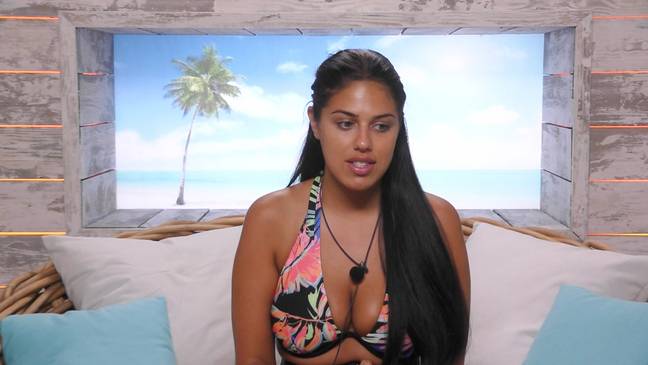
When I started Series 4 last year, Samira Mighty was the only black female contestant. This didn’t seem an issue to me at first, until I learned that she was the first black female contestant in the show’s entire run…

There’s a huge problem with that, but you might have thought that 1 out of the previous 40 female contestants might have been black (mixed race doesn’t count).

So Samira was the first black girl on Love Island, and when the boys got to choose which of the girls they wanted to be with… she was chosen last.

Samira said in an interview with the Mail ‘I was obviously the token [black woman] on the show, it was easy to work that out. I only had to look at the line of girls when I arrived at the villa.’

In the end it became quite painful to watch Samira’s journey, because the starting male islanders had roughly the same type ‘on paper’, small and blonde/brunette, with a nice tan…

This issue arose again in the 2019 villa, with the second black female contestant Yewande Biala -yes, a whole season later and we’re still only on two black girls. History seemed to be repeating itself when Yewande was also chosen last.

Samira said ‘Yewande is a token, too, it’s obvious what is happening. She is the only black girl, and has had little interest from the men, who seem to like blonde white girls with big boobs.’

Just to make myself clear, people do not have to find all people of all races attractive. Everybody has a preference. It is not the other islanders’ fault for being attracted to ‘blonde white girls with big boobs’, but if all the islanders have a thing for a white people, how are darker skinned contestants supposed to survive?

This is a problem with Love Island that is unfixable.

(side note: I know there have been black male contestants that have fared very well, and the same for mixed race contestants, but that is a whole discussion on ‘colourism’ that I don’t have time to write about now due to my self-imposed word limit. But in summary, typical standards of beauty for men and women are different, and race plays a big part in that. If you want to learn more about this then you can watch some of the videos in the handy playlist I have made here:  https://www.youtube.com/watch?v=02Pb2jqgjJg&list=PLOmqsxvpGvCjeJJB9pqhozrv0zwOxtBu5)

The same can be said for plus-sized contestants. Anna Vakili was the first ‘plus-sized’ contestant on the show… and yeah… she’s hardly plus-sized, she just tall and with a big bum…

Anyway, Anna Kardashian was with Yewnade among the last girls to be picked, and the two of them remained single for weeks, while the other fairer and petite girls were cracking on and having a good old time.

To reiterate, it is not the other islanders’ fault if they want to get to know other girls, but if the producers just dumps these girls in villa to tick a diversity box, without considering whether they’ll actually be viewed as attractive, they just reinforce the idea that you have to fit into a certain type to be viewed as attractive.

The same can be said for the male contestants. They all tend to have a particular body shape- muscular. And obviously there are exceptions, like last year’s winner Jack Fincham who had what was described as a ‘dad bod’.

But on the whole, the majority of the islanders have body types that the majority of people don’t have, and some believe that this can encourage negative feelings.

A survey released by the Mental Health Foundation showed that around a quarter of young people (aged 18 to 24) said that reality television made them feel negatively about their body image. Around a third of those surveyed said that the images used in advertising campaigns and promotional social media pictures also made them feel this way.

I asked on my instagram whether you felt that Love Island promotes negative ideas about body image and 84% of you said yes.

Richard Cowles, Love Island’s creative director, has responded to critics of the show’s lack of body diversity:

‘Yes, we want to be as representative as possible but we also want them to be attracted to one another… Also, we’re not saying that everyone that’s in there is how you’re supposed to look. We’re saying here’s a group of people that we want to watch for eight weeks, and we want to watch them fall in love. That’s not at the front of our mind, but we do want to be as diverse as possible.’

Perhaps he raises a fair point. The show is only eight weeks long, which feels like forever, but in the real world you would never be trying to look for ‘love’ in such a short amount of time. By having the islanders all fit a certain body type, he assumes that the initial attraction will come easily, and the islanders can move along faster.

But when so many people have a problem with this aspect of the show, shrugging your shoulders and saying ‘we want them to be attracted to one another’ is a poor answer.

And like we’ve seen with darker female contestants, the problem cannot be fixed by dropping a larger person in the villa to fulfil a diversity quota, as that will likely highlight more problems.

This is another aspect of the show that is unfixable.

The most glaring problem with the show is one that I’ll discuss briefly, because there really isn’t anything that can be done about it…

That is the show’s depiction of love and relationships.

Obviously, Love Island is a dating show, so we can’t expect anything other than what we’re getting at the moment. That said, it does reinforce outdated stereotypes about finding ‘the one’, as well as outdated stereotypes about gender. Male islanders are frequently told to ‘be a man’ and ‘take it like a man’.

As well as the challenges completed by the islanders frequently being based around gender stereotypes. For example the handy man, and the playboy bunny challenges from this year.

Love Island is perhaps the most heteronormative show on television BUT, this is perfectly normal for a dating show and the problems are (say it with me) unfixable.

Also some people have mentioned that they would like to see Love Island include some LGBTQ+ representation. That’s never going to happen, it wouldn’t work, stop asking for it.

The creative director said:

For a dating show, you need everyone to fancy everyone, so if you have gay and heterosexual in the same place, they’re not going to fancy each other.

And he’s completely right. An LBGTQ+ Love Island won’t work smoothly, not unless the villa is all same sex. Love Island is not the tv show for LGBTQ+ representation.

If you want that I suggest you watch the Bi Life (fair warning, it’s not very good).

So I guess I am saying that Love Island despite being an entertaining show is still a trash show, that cannot truly be changed or diversified without being seriously restructured or creating more problems.

Getting rid of smoking and reducing the amount of nudity doesn’t truly do anything to solve its problems. Love Island cannot possibly reflect the true diversity of love and attraction amongst every day people. And that’s the problem with Love Island, the show itself is one big old problem.

Plus, with Love Island set for TWO seasons next year…

I am sure the Love Island problem isn’t going anywhere.

I have so much more I could say, but I have already gone over my self-imposed word count. I am considering transitioning some of my planned blog topics to a video essay format for youtube, and Love Island is certainly the gift that keeps on giving, so perhaps I will revisit this topic in a video sometime.

But what do you think? Comment below, or beef me on instagram @__joejordan

all love,

Joe Jordan x

The Little Issue

Walt Disney Studios have finally announced the casting of Ariel in their remake of their 1989 classic ‘The Little Mermaid’.

The Little Mermaid, due for release in 2020 or 2021, will likely be Disney’s 19th remake of one of their classic animated features (more details to be announced).

So far, I have enjoyed these remakes with reluctance. I have enjoyed the sense of nostalgia in seeing these iconic films reimagined with an all star cast, and modern special effects…

But I am reluctant, because I know I am being played for a fool, being fed the same story over and over again by Disney, while paying them to do it.

Many people would much rather see new and original ideas coming from the Mouse House, but since their remakes keep making bank… that’s just not going to happen any time soon.

But to compensate for this regurgitation, Disney have been putting new spins on their classics, to modernise them and to address some of the issues surrounding the Disney brand… because realistically the messages in the original films are perhaps a little outdated now.

Maleficent (2014) does this best in my opinion, not so much a remake, but a complete reimagining, recounting the story of Sleeping Beauty from the villain’s point of view.

Other films don’t do this so well. Cinderella (2015) aimed to combat the negative portrayal of femininity embodied in its protagonist, by making her more less passive and more proactive.

This however created more issues with the character, because if Ella is less passive it begs the question ‘why does she let her step family treat her like a slave?’ To which the film answers ‘because she’s kind’…

Kindness doesn’t mean you have to be treated like crap…

Beauty and the Beast (2017) was another film that kinda half arsed the update. Disney announced that the character of Lefou would be their first ever gay character, and this naturally caused quite a stir, as the topic of LGBTQ+ characters in children’s media remains a controversial one.

But Disney gave middle America the middle finger and did it anyway… except they didn’t. 

This incredibly brief, blink-and-you’ll-miss-it moment at the end of the film doesn’t count, Disney.

But the issue of Lefou encapsulates the problem Disney faces with these remakes. Ultimately the films are being made to make money, and while the Mouse House can make money out of diversifying its characters, is can also lose money by diversifying its characters. Which is why ‘Lefou the first gay character’ was used a lot in the publicity for Beauty and the Beast, but when it actually came down to the film itself it’s never really mentioned… and Disney’s issue with representation goes on.

So that brings us to the Little Mermaid…

… she’s black now. Some people were surprised, others not so much, that Disney decided to ‘race bend’ this character, and cast black actress Halle Bailey in the role.

And actually, despite what you might have seen on twitter, this decision has been received generally well. I put up a poll on my instagram two days ago, asking ‘is it important that Ariel is white?’ and only 3% of people felt it was.

There will always be those people who wanted Ariana Grande in the role, but I’m gonna be honest with you, she can’t act.

But what is the problem with casting a black Ariel? Personally, I don’t see an issue with changing the race of this character, as her race and her cultural heritage is not a part of her story.

Yes the original story was written by Danish Author Hans Christian Anderson, and some have argued that the cultural heritage of the author should be respected, and therefore Ariel should be white.

But honestly, by a show of hands, how many people actually knew that the Little Mermaid was a fairytale by Hans Christian Anderson, and presumably set in Denmark…

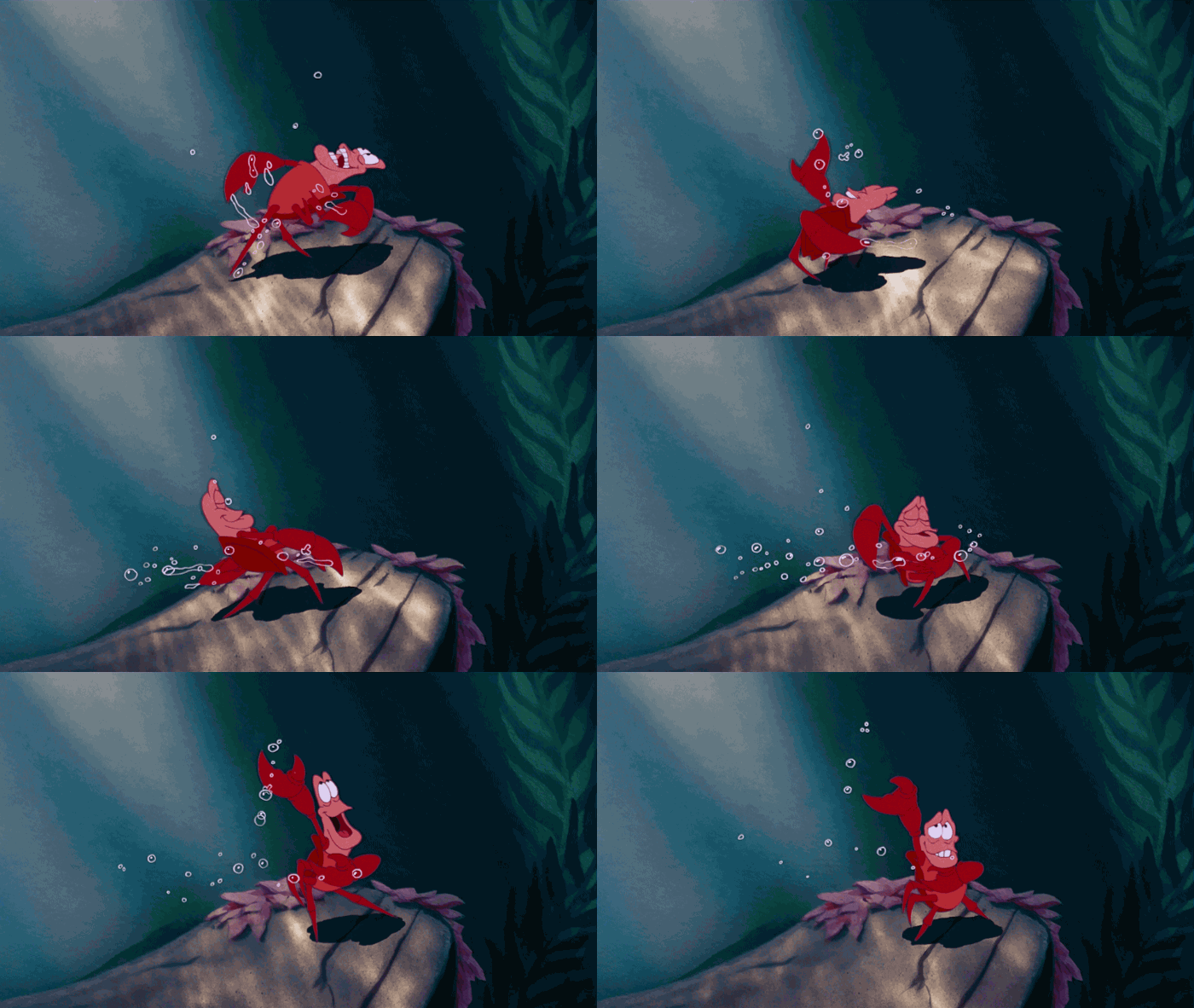
I mean, I knew… obviously… when people think of the Little Mermaid, people think of the Disney film. Which appears to be located somewhere in the Caribbean, due to the abundance of different sea life, and Ariel’s Jamaican crab friend, Sebastian.

Or it could be set in Greece, as Ariel’s father is named Triton after the Greek god.

Or maybe it’s set in the New World, as Prince Eric has an American accent?

The point I’m making is that the original film clearly didn’t care about where the fairytale was supposed to be set and neither should you. If you want book loyalty, I assume you’ll be expecting Ariel to fail in her attempts to get the prince and commit suicide at the end? (yeah the book is pretty dark).

But of course there’s that classic argument, ‘but if a black princess was cast as white it wouldn’t be allowed.’

Okay. Name one. Name a black princess. And don’t say Tiana, she doesn’t count, because ‘The Frog Prince’ is a German fairytale, and nobody complained when she was portrayed as black in the Disney film.

As of now, there two black Disney Princesses. Yes Disney could create a new Princess and have her be black, or draw inspiration from an African folktale, but as stated before, their remakes are making too much money for them to stop and do something original.

I asked on my story if casting non-white actors to play ‘white roles’ is the same as casting white actors to play ‘non-white roles’, and the results were a bit more split on this one.

Here’s what I think. There’s not an abundance of roles out there for actors of ethnic minorities, and the roles that do exist are often based around the character’s race, i.e portraying slaves, or the help. Not that there is anything wrong with these films, many of them are great pieces of cinema and have important messages, but it’s nice to see a film with a black lead where their race isn’t important.

As such, I believe it is generally permissible to cast an actor of any race in a role where the character’s race or general appearance is not relevant to the characters story.

So no, casting a white Black Panther is not the same as casting a black Ariel, because T’Challa is The BLACK Panther and King of an African Nation.

It’s okay to change to the race of characters, as long as it is done properly and logically. For example there is a problem with casting ethnic minority actors in historical eras which they don’t belong.

This most stood out to me recently in Mary Queen of Scots (2018), where English noblewoman, Bess of Hardwick was portrayed by Gemma Chan, because Bess of Hardwick was a real person who was white.

However, this isn’t a problem in the BBC’s ‘The Hollow Crown’ where Queen Margaret of Anjou is portrayed by Sophie Okonedo… because it’s not really history, it’s Shakespeare and he kind of fits into the same category as fairytales do (don’t argue with me on this one, Shakespeare is not history)… hmmm…

I’m going off on a tangent here. What I am trying to say is the issue of race bending isn’t black and white (lol), it’s entirely circumstantial. It’s important to consider what changing the race of a character means, and the context of the story in which the character is set. There cannot be a blanket rule for this issue, because it’s more complicated than that.

I asked you guys on Instagram what you thought about black Ariel and here are some of my favourite replies, and replies that I think best capture the general feeling on this casting decision.

I was going to talk about Tokenism vs Representation, but I’ve gone on long enough, so I won’t shoehorn a perfectly good blog post topic into the end of this one.

So in summary, Walt Disney Studios are trying to modernise, and that means occasionally diversifying its characters. Most people don’t think it’s an issue, but the fact that there has been such a large discussion surrounding it is interesting.

But realistically, in 20 years time, who will remember this little issue? Nobody will care.

But what do you think? Comment below or beef me on instagram @__joejordan

all love,

Joe Jordan x

Game of Clothes

So it’s finally finished. After watching Game of Thrones for the last eight years (yes I was far too young when I started) this show has finally come to an end… and… yeah, it wasn’t great.

There has been a lot of online debate about the end of this epic show, and I don’t really know what I can add to the discussion. Season 8 was rushed, it was shocking (not in a good way), and it was ultimately anticlimactic.

If you read my last review on Episodes 3 and 4, you’ll know that I was less than happy with the conclusion to the White Walker storyline. After the death of the Night King, the rest of the show was doomed in my eyes.

You can read that here: https://joejordan.home.blog/2019/05/09/the-short-night-got-eps-3-4-brief-thoughts/

So due to my disappointment, I am not going to review the last 2 episodes, but if you’re looking for some good reviews I’ll put some recommendations at the end.

Instead I am going to focus my attention on something that I find personally irksome about Game of Thrones; the show’s increasingly lack of realism, and constant tone changes. I don’t mean this in regards to the story and character (although I could), but rather the costumes and over all aesthetic of the show.

In Seasons 1 and 2 there was a strong sense of reality to the visual aesthetic of Westeros and Essos.

Things were imperfect, even ugly at times. King’s Landing looked like a sweaty and uncomfortable place, where you’d be bitten to shit by flies.

It reminded me of Rome… not the place, but that other massive HBO series- which you should totally watch btw, especially if you’re missing classic Game of Thrones.

The first two seasons of Thrones presented a fictional world that felt as if it might have actually existed in our own history.

In Season 3, everything got better looking- which I personally didn’t like. The humidity of Kings Landing was no longer taking its toll on Cersei Lannister’s hair, which now appeared to be perfectly curled, not a stray hair in sight… almost like she had a curling iron… hmmmm…

Likewise all of the other women in the show were suddenly styling lush and voluminous hair, the kind you’d see in a shampoo advert, not in a period piece.

The characters also suddenly felt more tailored, and the fabrics felt richer… which wasn’t necessarily a bad thing, but these small changes made the show feel prettier than it previously had, and compromised the realism. The characters in the show felt so much cleaner and more processed than before, that they kind of looked like a really good cosplay of themselves.

This continued into Season 4, where the characters continued to feel more and more processed. Their clothes felt more and more like costumes, rather than real items of clothing. The costumes felt more costumey, and the wigs felt more wiggy, encapsulated in Lysa Arryn whose brief appearances in Seasons 1 and 4 perfectly show the contrast in wig quality.

Yes her Season 4 hair looks far more voluminous and the wig is clearly expensive, but does it really look more convincing than Season 1? I don’t think so.

Season 4 also introduced ‘Dark Sansa’, which in my view is one of the more ridiculous looks a character has donned. In Season 1 when Sansa say’s she made her own dress, I totally believed her because he dress was so ugly and ill fitting.

But in Season 4 I mean seriously? She MADE that black raven feather dress herself? With just a needle and thread? I don’t believe you.

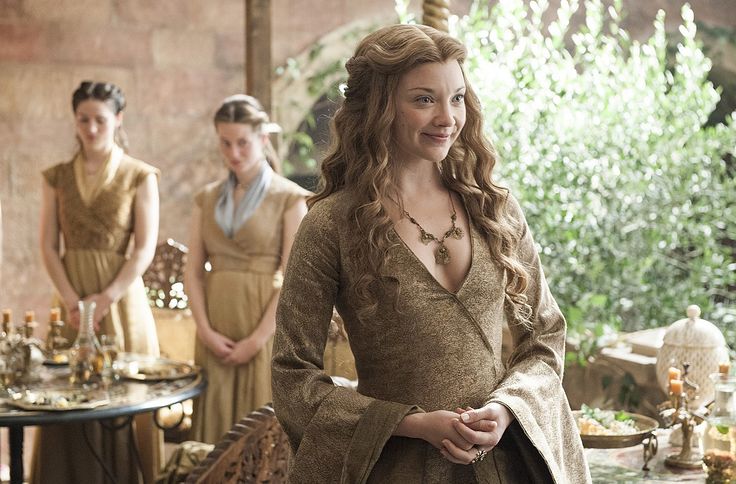
In the fifth and sixth seasons things got even less believable than before. Cersei and Margaery’s wigs were the biggest casualties.

I MEAN COME ON. How much hair does Margaery have? And how hasn’t it broken her neck yet?

These seasons were also weird, as the tone became at lot more… muted? I guess that’s the word I’m looking for? Courtyards that had once felt convincingly outside, suddenly felt… inside, like there was no natural light actually on them.

I know obviously there wasn’t any natural light on them as they’re obviously sets, but previous season had managed to convincingly make these areas feel as though they were really outside.

Also the Kingdom of Westeros began to feel less inhabited. Those same courtyards that had once been teeming with courtiers and servants were suddenly…

…not. It felt like crowds just turned up when they were needed for big scenes, but otherwise there we no other people in around.

Season 6 did some very odd things towards the end costume wise.

I don’t believe that anyone in this world would have made this garment, it’s disgusting, ugly and cumbersome, and I hate it.

I don’t believe this outfit exists in the same world as the costumes of Season 1. Can you really imagine Cersei commissioning this? ‘I want a big leather coat with armoured shoulders with a chain hanging from them.’ Who would she even ask to make this?

Same thing with Daenerys. Who is making her ever changing wardrobe? When she’s in Meereen she has so many costume changes it’s ridiculous.

This is particularly annoying, because in the books she makes a decided effort to adopt the dress sense of Meereenese, because that is a logical decision for her to make.

This is the same show that kept Arya Stark in the same costume for over three seasons, because it made no logical sense for her to change clothes.

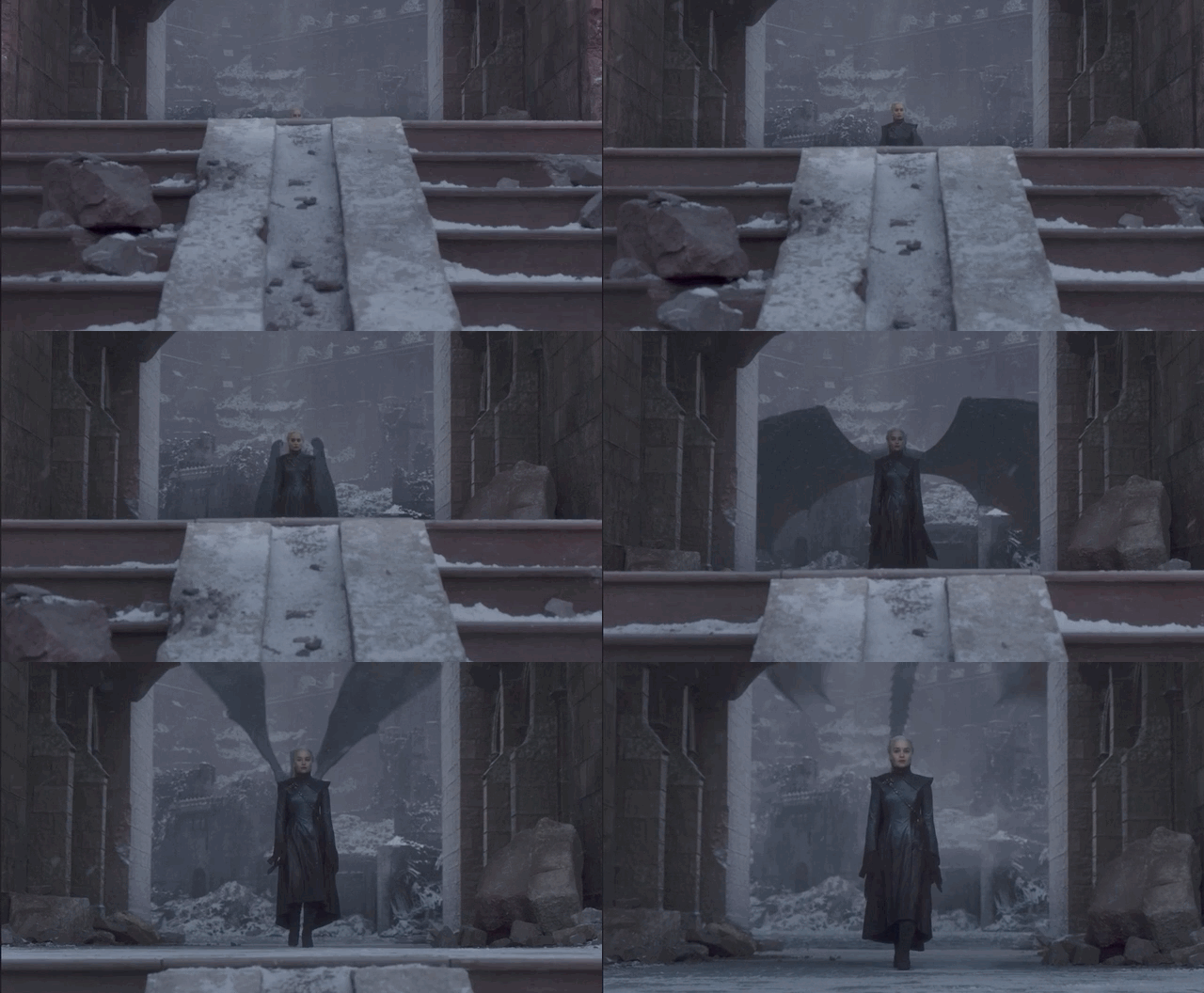
Seasons 7 and 8 of Game of Thrones are SO weird looking. It’s so weird that Daenery’s left for Westeros wearing gowns like this…

… and arrives wearing this.

I guess someone made this on the boat? Or before she left Meereen, where is BLAZING HOT, she commissioned a whole new wardrobe, consisting of thick structured coat/dresses? Obviously it’s possible, but I just don’t believe you. Who is making all of these intricate garments? Where has the logic in the clothing gone?

And WHAT is this?

The costumes of this show used to feel historical and utilitarian.

Season 2 Daenerys in the Red Waste

But by the end of the show’s run there is no realism to them at all… which is rather fitting I suppose, as the shows writing takes a similar turn.

I think Season 8 wins the trophy for the most ridiculous wig, how many plaits is it possible for one woman to have?

Sansa looks more like Darth Vader than a lady of the approximate Medieval period.

Cersei looks like an uncomfortable arm chair.

And Varys is giving us some Theresa May asymmetry, (not necessarily a bad thing).

By the end of the show, the characters have diverged so far from their original looks, and this didn’t necessarily have to be a bad thing. It’s great to see character development through costume design, but that shouldn’t come at the cost of reason and logic.

Why has their hair colour changed so much?

I feel that this show’s writing went downhill because it forgot where it came from, and I believe it’s the same with aesthetic. They lost sight of the historical and focused more on the attractive, or cool. I obviously recognise the hours and hours of painstaking work that goes into making a show like this, and I’m commend that dedication… but…

I ain’t buying it.

But what do you think? Do you like the costumes in the later seasons of Game of Thrones? Comment below or beef me on Instagram @__joejordan, and if you’re looking for some great reviews on Game of Thrones Season 8, check out these guys below.

Linda from westeros.org: https://www.youtube.com/user/Balerion300

Ideas of Ice and Fire https://www.youtube.com/channel/UC1rFmaGLYr0Ve_Y_soxZNWQ

Red Team Review: https://www.youtube.com/user/XIIICarmine

all love,

Joe Jordan x

The Short Night: GoT Eps 3 & 4 – Brief Thoughts

If you’ve read my last blog post on this subject, you’ll know that I have felt rather let down by the first two episodes of Game of Thrones, Season 8.

But I went into Episode 3 optimistically, with hopes that the dull start of the season would be rectified by the start of the Great war.

I was sadly disappointed to see the END of the great war in this episode too.

I am not furious the Arya killed the Night King, I do think it’s incredibly dumb, but fine whatever…

Arya kills the Night King, I can accept that. What I cannot accept is that she killed him NOW, 3 episodes into the last season WHICH IS ONLY 6 EPISODES.

The White Walkers have been set up as the big bad of the series since before we first saw the opening credits of the first episode.

The White Walkers are like the gods of this world, supernatural beings that are 1000s of years old and have MAGIC POWERS, and they get entirely wiped out in a single episode.

One of the growing dreads of Game of Thrones has been the fact that the characters a squabbling over a chair and that ultimately it DOES’NT MATTER, because the White Walkers (aka GLOBAL WARMING) is coming for all of them anyway.

At the end of last season when Cersei revealed that she would not be sending aid to The North, it was so annoying, because she was so wrong. It was presented like a really stupid decision, like all of her decisions, but NO! She was right!

The White Walkers actually weren’t that big of a threat, and she was right to withhold her forces.

And I hate that. I always interpreted the White Walkers as a cross between global warming, and the horrifying realisation that Satan and all his demons are real.

Imagine that, Satan himself, at the head of an army of anthropomorphised global warming, and he’s just wiped out by one person with a knife in less than 24hours. That’s how dumb the end of this episode was.

I think that the army of the dead should’ve won, but if the Night King must die, then it should have been the end of Episode 6.

Think of all the unanswered questions!

It wasn’t all bad this episode, I was happy to see the return of Melisandre of Asshai.

The Red Woman has always been an otherworldly presence in the series, demonstrating the bizarre and alien powers since her introduction. Carice Van Houten was perfectly cast in this role and it was bitter sweet to see her go.

However, with her departure and the death of Beric Dondarion, we have more unanswered questions…

So God exists in this universe then? I mean it looks like he does, and it looks like he grants power to his worshipers, so why isn’t everyone converted?

Episode 4 started nicely, I know it’s received mixed reviews, but structurally I didn’t think there was any huge issue (there actually are structural issues, but the show is a piece of shit now, so this episode didn’t stand out a particularly structurally weak).

For example I was a fan of Rhaegal’s death as a plot point, but as is often the case with Game of Thrones, it was the execution that was poor.

Come on, how could Daenerys not see Euron’s ships from dragon back?

Also I don’t believe this weapon exists.

There were some other weird things in Episode 4, like the characters barely mention that Arya killed the Night King and put an end to the Great War!!!!!

They should be losing their shit, chest bumping and crying and screaming, but everyone just seems to kinda get over it and move on.

Also Arya is a trained faceless assassin… why not try sending her to kill Cersei? I’m sure that’s the sort of thing she could do, considering she JUST KILLED THE NIGHT KING.

My main issue with Episode 4 is that it shouldn’t exist the way it does. I strongly believe the Night King should have won the Battle of Winterfell and a select group of characters should have escaped south.

I think once the season is done, I am going to rewrite it as I think I should have been (briefly of course, short enough to fit in a blog post xx).

Also I was kinda sad to see the end of homegirl.

This show has gone in such a weird fanfiction direction, and like a prisoner with Stockholm Syndrome I’ll be returning next week for more.

But what did you think about this episode? Comment below of beef me on instagram @__joejordan.

All love,

Joe Jordan x

Why So Boring? : Men’s High Street Fashion

So if you know me, or get to know me, you’ll know that I’m a big fan of clothes. I have loads of clothes, so many that there’s no chance of me fitting them all in my wardrobe.

I’ve recently returned to university, and as most students do when they get their loans, I went shopping (don’t worry mum, I haven’t bought anything).

My reason for not buying anything is not that I’m trying to save money (joking mum, I’m saving my pennies), but because in recent years I’ve been finding high street fashion so boring, particularly men’s- women have it a bit easier.

I hate being that guy, because it’s so lame when people slag off high street fashion like they’re the epitope of stylish individualism…

…but seriously if I go into another high street shop and all I see is muscle fit t-shirts and spray on jeans, I WILL flip.

It’s not just me though, earlier this week I asked people on instagram what they think about men’s high street fashion. Here are some of the responses.

‘Pretty naff’

‘Decent but not enough option’

‘Men’s clothing seems so borrrrrrring n basic’

‘Most high street stores tailor to shit fashion sense, which means you can’t branch out and showcase a diverse style’

And simply ‘shit’

I also put out a poll asking people if they preferred high street or charity shops. 26% of people voted high street, and 74% voted charity.

Now of course my humble instagram account cannot provide objective data, but it does seem like more and more people are moving away from high street fashion, in search of something that seems a little more personal. My sister prefers the term ‘pre loved’ rather than ‘second hand’.

On that note, to the ladies reading this, my sister has a really cool online shop where she sells the coolest range of vintage women’s clothing.

If you’re looking for a special and unique gift, or perhaps something for yourself, you should check her out here: https://marketplace.asos.com/boutique/cats-eyes-vintage

My friend Alice also did a blog post about her here: https://alspalss.wordpress.com/2019/04/25/sustainable-fashion-with-cats-eyes-vintage/

I am a champion of the charity shop, especially due to the wider variety of clothing compared to the high street. Not only can you find something swick binching, but you can at a faction of the cost.

So, this past weekend I went to Leeds to do the famous (or infamous?) Otley Run. For those of you who don’t know, the Otley Run is a pub crawl comprised of 16 pubs, which groups of people often complete dressed to a theme.

The theme my friend Hats chose for her Otley Run was famous musical artists. I went Adam Ant, whom I’m a fan of for his music and outlandish dress sense.

He is an artist from the 80s, around the same time as such greats like David Bowie, Freddie Mercury, Prince and Michael Jackson(…)

Comparing these guys to the male artists of today, I wonder if men’s fashion on the whole has become a bit boring?

I’ll leave you with two of my major fashion inspirations, both of whom are absolutely killing AND are promoters of indivuality and sustainable fashion.

For the dudes: Gus Dapperton

Gus Dapperton is a 20 year old singer from New York, who not only makes the swickest music, but also wears the swickest garms. Check this out.

Gus has been a major inspiration to me this year, his unapologetic look and swagger has really inspired me to be more adventurous with my outfit choices.

For the chicks: Sophia Hadjipanteli

This girl is down right the coolest person I’ve ever seen. Sophia Hadjipanteli is that model with the uni brown, you may have seen her. Love it or hate it, Sophia doesn’t care, she’s just doing her own thing.

Instead of getting rid of her natural unibrow, she’s embraced it and made it a statement, and she perfectly accentuates her look with a killer dress sense.

I mean, just look at this. I love it.

I know these two aren’t everyone cup of tea, but this is my blog.

This isn’t a criticism of guys who like to wear jeans and a t-shirt everyday, you’re a vital part of society as you make the rest of us look good.

So yeah, blah, blah, I’m getting bored of the high street. Are you? Comment below or beef me on instagram @__joejordan.

All love,

Joe Jordan x

Lame of Thrones?

SPOILERS ARE COMING

Game of Thrones finally came back to our screens last week, after 595 days of waiting… not that I was counting.

Episode 1 (non-creatively titled ‘Winterfell’) was a strong starter, not anything particularly spectacular from a narrative point of view, but still, it was only the first episode. The narrative purpose of Episode 1 was to reintroduce the characters and establish the threat of the dreaded Night King and the army of the dead.

Daenerys arrives in the North to a cold reception, but is vouched for by Jon. Jaime arrives in the North to cold reception, but is vouched for by Brienne.

This week in Episode 2 (‘A Knight of the Seven Kingdoms’) we saw a beloved character arrive at Winterfell, only to receive a chilly reception in the Great Hall.

Jon and Arya discuss their last encounter. Bran and Jaime discuss their last encounter.

Also this week, two characters who haven’t interacted since the first season reunited in the Godswood.

Jon finds out about his true parentage. Daenerys finds out about Jon’s true parentage.

And at the end of the episode, in the Winterfell crypt, Jon Snow’s true parentage was revealed to a significant character… hang on… I saw all that last week?

I know that last week they were all different characters, but these were the only significant things to happen in Episode 2, and they were beat by beat repeats of last week.

What was the real purpose of this episode? Think about it. What did we, the audience, learn this week that we didn’t already know?

Jon Snow is a Targaryen?

Season 6 Episode 10

Nope. We’ve known that for a while.

Winter is coming?

Season 1 Episode 1

Yeeeeaaaahh, um… we know that too.

Arya has a sex drive?

Okay maybe we learned something new this episode… perhaps I’ll write about that particular scene another time.

At the end of this episode I found myself asking a question I’ve asked for a few seasons, is Game of Thrones becoming lame?

If we compare what happened and what we learned in first two episodes of Season 1 to Season 8, there is a stark contrast (pun intended).

Season 1 wasted no time establishing all of the characters in its opening episode (Winter is Coming), and setting up the main narrative of not only the first season, but of the show itself. Substantial plot points occur in this episode that get the story moving.

Ned Stark agrees to be the Hand of the King.

Daenerys receives three dragon eggs as a wedding gift.

Bran is pushed from the window.

Nearly everything that happens in this episode is relevant and leads nicely into Episode 2 (‘The Kingsroad’).

Episode 2 does what every second episode should do- takes the wheels set in motion by Episode 1 and goes cruising. And again, we get substantial plot points that keep the story going.

Joffrey’s true nature is revealed, leading to the death of Sansa’s wolf.

Catelyn fights off an assassin armed with a Valyrian steel dagger.

Bran wakes up.

The show used to be so dense with expert story telling, that kept us on the move and kept us interested, without ever feeling as though time was being wasted. Even when a scene did start to feel a bit dry, it was always jam packed with relevant information.

Season 8 has only six episodes, and then there’ll be no more Game of Thrones! So why waste an episode like this? At the end of Episode 2, we’re essentially at the same place as were at the end of Episode 1.

Many people have noticed a drop in the quality of storytelling in the last few seasons of Game of Thrones… and I wonder why that is?????

Oh yeah… lol.

As a die hard fan of the show, I can’t help but feel a sense of disappointment with the direction the show runners have taken over the last few seasons.

Now the writing of the show feels frequently lazy and clichéd. Don’t get me wrong, the production value is insane…

…but it would be far more enjoyable if the story was at a similar standard. After all, that’s what made the show so great to begin with.

Anyway, I still think it’s still the best show on TV right now, and every season has its duds. Next week looks promising, so fingers crossed Game of Thrones won’t be Lame of Thrones.

But what do you think? Game or Lame? Comment below or beef me on instagram @__joejordan

https://www.instagram.com/__joejordan/

Design a site like this with WordPress.com
Get started